Huckleberries: The Wild Berry with Powerful Health Benefits
Wild-harvested and often richer in anthocyanins than blueberries — what the science says about huckleberries and how to use them in pies, syrups, and smoothies.
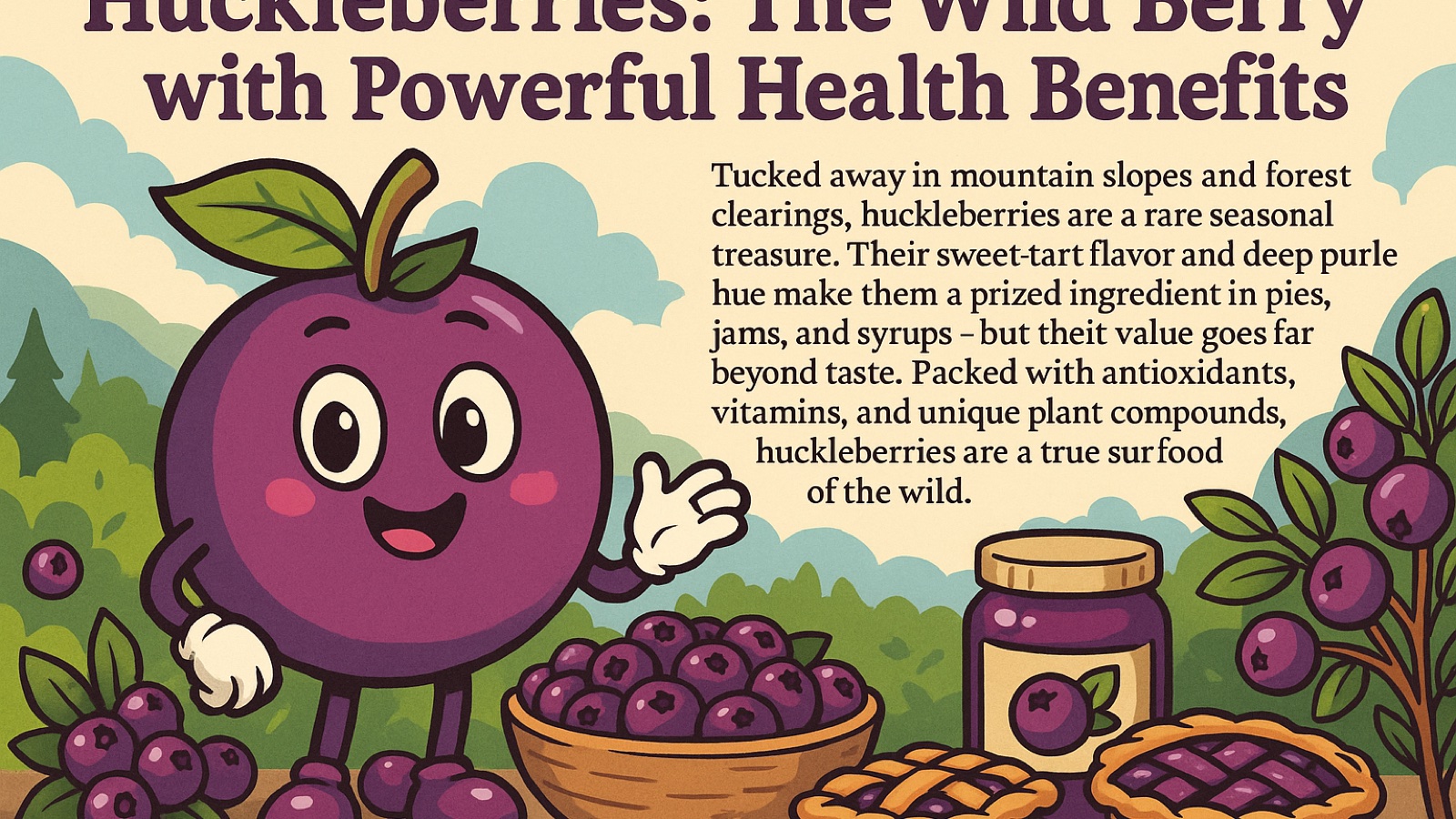
Tucked away in mountain slopes and forest clearings, huckleberries are a rare seasonal treasure. Their sweet-tart flavor and deep purple hue make them a prized ingredient in pies, jams, and syrups. But, their value goes far beyond taste. Packed with antioxidants, vitamins, and unique plant compounds, huckleberries are a true superfood of the wild.
Nutrition & Science-Backed Health Benefits of Huckleberries
Huckleberries are closely related to blueberries and share a similar nutrient profile, but often boast higher antioxidant levels due to their wild growth. One cup (148g) of raw huckleberries contains approximately:
- Calories: 84 kcal
- Fiber: 3.6g
- Vitamin C: ~24% DV
- Manganese: ~25% DV
- Polyphenols: High in anthocyanins, flavonols, and phenolic acids
Scientific Studies & Meta-Analyses
- Cognitive Health & Aging
- A 2022 systematic review and meta-analysis of 13 randomized controlled trials found that anthocyanin-rich (berry) supplementation improved processing speed in older adults. PubMed
- Antioxidant & Anti-Inflammatory Properties
- Laboratory analyses of Pacific Northwest huckleberries (Vaccinium membranaceum and V. ovatum) documented high anthocyanin and total phenolic content and strong antioxidant capacity, with profiles comparable to (and in some cases exceeding) cultivated blueberries. J. Agric. Food Chem. 2004
- Blood Sugar Regulation
- In a controlled, randomized crossover trial in overweight/obese adults, an anthocyanin-rich mixed-berry intervention reduced post-meal insulin area-under-the-curve compared with matched controls. Nutrients 2019
- Heart Health
- A 6-month randomized, double-blind trial in adults with metabolic syndrome found that 1 cup/day of blueberries (rich in anthocyanins) improved endothelial function and HDL-related metrics (with no change in blood pressure). Complementary evidence: improved endothelial function over 6 weeks in a separate RCT. PMC
- Eye HealthReviews and experimental studies on bilberries (a close Vaccinium relative) report anthocyanin-mediated support for retinal blood flow, rhodopsin regeneration, and visual function—mechanisms likely relevant to wild huckleberries with similar anthocyanin profiles. Food & Nutrition Research 2017 (PMC review) | Lab Invest 2012 (bilberry extract; retinal inflammation)
How to Choose the Best Huckleberries
- Fresh: Look for plump, uniformly colored berries without mold or shriveling.
- Frozen: Opt for unsweetened varieties to avoid added sugars.
- Dried: Should be pliable and not overly hard; check for no added syrups.
Wild foraging tip: Only harvest from clean, pesticide-free areas and be certain of correct plant identification.
How Huckleberries Are Enjoyed Around the World
- Pacific Northwest, USA: Baked into pies, cobblers, and muffins.
- British Columbia: Made into preserves and syrups for pancakes and waffles.
- Sweden: Used similarly to bilberries in jams and traditional desserts.
- Russia: Incorporated into sweet dumplings or served with cream.
10+ Tips to Prep & Use Huckleberries Like a Pro
- Rinse gently: Use cool water just before eating.
- Freeze flat: Spread on a tray before bagging to avoid clumping.
- Blend into smoothies: Pairs well with banana and almond milk.
- Fold into yogurt or oatmeal: Adds antioxidants and natural sweetness.
- Make huckleberry syrup: Perfect over pancakes or ice cream.
- Bake into muffins or bread: Retains flavor after baking.
- Cook into savory sauces: Great with game meats like venison or duck.
- Mix into salads: Combine with goat cheese and walnuts.
- Create fruit leather: Dehydrate blended huckleberries for snacks.
- Infuse in vinegar: For unique salad dressings.
- Add to chia pudding: For fiber and antioxidants.
Final Thoughts: A Wild Treat Worth Seeking Out
Huckleberries aren't just a seasonal delight, they're a nutrient-rich, antioxidant-packed boost for your brain, heart, and immune system. Whether you find them fresh in the mountains, frozen in stores, or tucked into a jar of jam, these wild berries are worth adding to your diet.
References
- Feng RC, Dong YH, Hong XL, Su Y, Wu XV. Effects of anthocyanin‑rich supplementation on cognition of cognitively healthy middle‑aged and older adults: a systematic review and meta‑analysis of randomized controlled trials. Nutrition Reviews. 2023;81(3):287–303. doi:10.1093/nutrit/nuac055. Available at: https://pubmed.ncbi.nlm.nih.gov/35960187/
- Lee J, Finn CE, Wrolstad RE. Comparison of anthocyanin pigment and other phenolic compounds of Vaccinium membranaceum and Vaccinium ovatum native to the Pacific Northwest of North America. Journal of Agricultural and Food Chemistry. 2004;52(23):7039–7044. doi:10.1021/jf049108e. PDF: https://www.ars.usda.gov/ARSUserFiles/37108/pdf/2004jagricfoodchem52_7039_7044.pdf
- Solverson PM, Henderson TR, Debelo H, Ferruzzi MG, Baer DJ, Novotny JA. An anthocyanin‑rich mixed‑berry intervention may improve insulin sensitivity in a randomized trial of overweight and obese adults. Nutrients. 2019;11(12):2876. doi:10.3390/nu11122876. Available at: https://pmc.ncbi.nlm.nih.gov/articles/PMC6950395/
- Curtis PJ, Van Der Velpen V, Berends L, et al. Blueberries improve biomarkers of cardiometabolic function in participants with metabolic syndrome: results from a 6‑month, double‑blind, randomized controlled trial. American Journal of Clinical Nutrition. 2019;109(6):1535–1545. Available at: https://pmc.ncbi.nlm.nih.gov/articles/PMC6537945/
- Rodriguez‑Mateos A, Rendeiro C, Bergillos‑Meca T, et al. Intake and time dependence of blueberry flavonoid‑induced improvements in vascular function: a randomized, controlled, double‑blind, crossover trial. American Journal of Clinical Nutrition. 2013;98(5):1179–1191. doi:10.3945/ajcn.113.066639. PubMed: https://pubmed.ncbi.nlm.nih.gov/24004888/
- Khoo HE, Azlan A, Tang ST, Lim SM. Anthocyanidins and anthocyanins: colored pigments as food, pharmaceutical ingredients, and potential health benefits. Food & Nutrition Research. 2017;61(1):136177. doi:10.1080/16546628.2017.1361779. Available at: https://www.ncbi.nlm.nih.gov/pmc/articles/PMC5613902/
- Miyake S, Takahashi N, Sasaki M, et al. Vision preservation during retinal inflammation by anthocyanin‑rich bilberry extract: cellular and molecular mechanism. Laboratory Investigation. 2012;92(1):102–109. doi:10.1038/labinvest.2011.132. PubMed: https://pubmed.ncbi.nlm.nih.gov/21894150/
Note: The information provided should not replace professional medical advice.