What You Should Know About Synthetic Food Dyes: A Friendly Guide
From hyperactivity studies to the FDA's 2026 phase-out plan — what the research says about artificial food colors and how to choose safer alternatives.
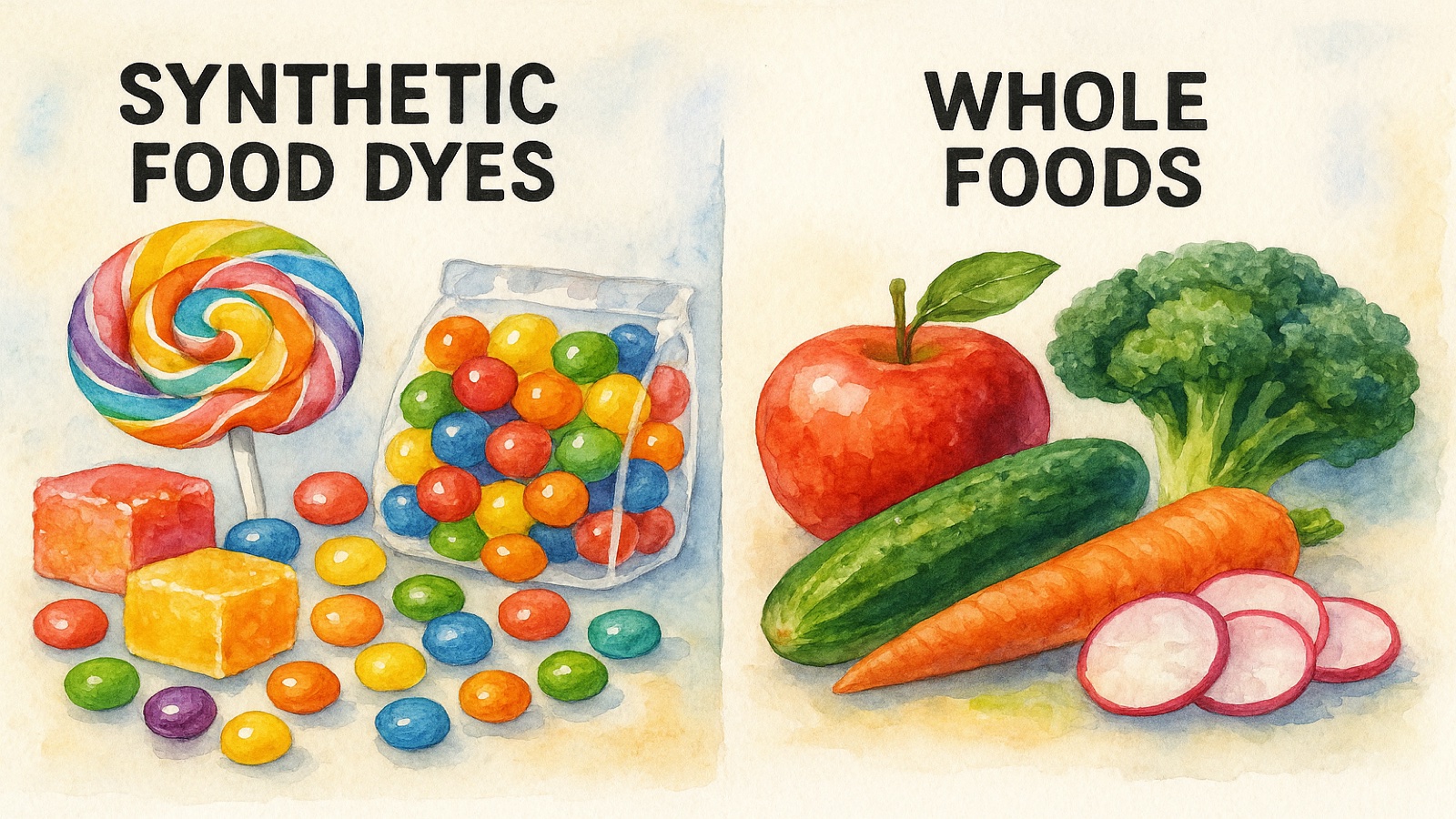
Have you ever torn open a packet of candy or a colorful cereal box and marveled at those vivid reds, blues, and greens? You have probably seen synthetic food dyes at work, which brighten everything from fruit snacks and frosting to sports drinks and ice pops. But have you ever paused to wonder what these artificial colors actually are, and what they might be doing inside your body?
Let's dive into what science has uncovered about synthetic dyes and why governments, including the U.S., are beginning to take more decisive action regarding their use in our food supply.
What Science Says: A Look at the Evidence
Here are some of the most cited and trusted studies examining the effects of synthetic dyes:
1. McCann et al. (2007), The Lancet
This rigorous randomized, double-blind study involving 297 children aged 3 and 8/9 years provided compelling evidence linking artificial food colors to hyperactivity. Researchers observed a statistically significant increase in hyperactive behaviors in children who consumed a mixture of common artificial dyes, including Tartrazine (Yellow 5), Sunset Yellow (Yellow 6), Carmoisine (Red 122), Ponceau 4R (Red 124), and Brilliant Blue (Blue 1), along with the preservative sodium benzoate. The meticulous design of the study, with its placebo control and blinded assessment, strengthened the reliability of these findings and sparked considerable debate within the scientific and regulatory communities.
2. Bateman et al. (2004), Archives of Disease in Childhood
This large community-based study focused on a general population sample of 277 preschool children aged 3 years. Employing a double-blind, placebo-controlled challenge, the researchers investigated the impact of a mixture of artificial food colorings and a benzoate preservative on hyperactivity. Notably, the study documented increases in hyperactive behavior as reported by both parents and teachers, suggesting a broader impact beyond just clinical populations and highlighting the potential for these additives to influence everyday behavior in young children.
3. Rowe and Rowe (1994), Journal of Pediatrics
This double-blind, placebo-controlled trial specifically examined the effects of Tartrazine (Yellow 5) on 34 children aged 2 to 14 years. The study revealed that the ingestion of Tartrazine led to observable increases in irritability and sleep disturbances in some children. The dose-response relationship suggested that even at levels commonly found in food products, this particular dye could elicit adverse behavioral reactions in susceptible individuals, prompting recommendations for cautious use, especially in pediatric populations.
4. Nigg et al. (2012), Clinical Psychological Science
This comprehensive meta-analysis delved into the complex interplay between genetic predisposition and environmental factors, focusing specifically on the role of artificial food dyes in attention-deficit/hyperactivity disorder (ADHD). While the review concluded that synthetic dyes are unlikely to be a primary cause of ADHD, it found statistically significant evidence that these additives can exacerbate ADHD symptoms in children who are genetically more susceptible. The effect size was characterized as modest but meaningful, underscoring the potential for dietary interventions to play a role in managing ADHD symptoms in a subset of individuals.
5. Arnold et al. (2012), Neurotherapeutics
This in-depth review explored the underlying biochemical mechanisms through which artificial food colors might exert their effects on behavior. The authors synthesized existing research to propose that synthetic dyes could influence the release of histamine, a neurotransmitter involved in inflammation and brain signaling, and potentially disrupt other aspects of brain chemistry. This analysis provided a biological plausibility for the behavioral changes observed in other studies, moving beyond purely observational findings to suggest potential pathways of action.
6. Schab and Trinh (2004), Journal of Developmental & Behavioral Pediatrics
This meta-analysis aggregated the findings of 15 double-blind, placebo-controlled trials investigating the link between artificial food colorings and hyperactivity in children. The combined evidence from these studies led the authors to conclude that artificial food colorings are indeed associated with a statistically significant increase in hyperactivity. This meta-analysis reinforced the concerns raised by individual studies and suggested that a notable proportion of children may exhibit sensitivity to these widely used food additives.
7. Nigg et al. (2012), Journal of the American Academy of Child & Adolescent Psychiatry
Another significant meta-analysis by Nigg and colleagues reviewed a broader range of 34 studies to assess the impact of artificial food colors on children's behavior, with a particular focus on those with ADHD. The findings indicated a small but statistically significant effect of artificial food colors on behavior, especially in children diagnosed with ADHD. The authors estimated that approximately 8% of children with ADHD might experience symptoms that are related to the consumption of synthetic food colors, highlighting a potentially modifiable environmental factor for this population.
8. Stevens et al. (2013), Clinical Pediatrics
In their meta-analysis of 24 studies, Stevens and co-authors further solidified the association between artificial food dyes and increased ADHD symptoms in a subset of children, particularly those already facing attention-related challenges. Their work emphasized the need to consider artificial dyes as a potential environmental trigger that could contribute to or worsen symptoms in vulnerable individuals. The authors recommended that clinicians and parents be aware of this potential link when addressing behavioral issues in children.
What the Studies Tell Us
The cumulative weight of this scientific evidence strongly suggests that synthetic food dyes can contribute to behavioral problems, particularly hyperactivity, irritability, and sleep disturbances, in a significant number of children. While individual susceptibility varies, the consistency of these findings across different study designs and populations raises considerable concern about the widespread use of these artificial additives in the food supply, especially in products marketed towards children. The potential biochemical mechanisms identified by researchers further support the biological plausibility of these behavioral effects.
Evolving Global Perspectives and Government Policies on Synthetic Dyes
The growing body of scientific evidence has prompted increasing scrutiny from regulatory bodies and governments worldwide, leading to a more cautious approach towards the use of synthetic food dyes.
In the United States, the landscape regarding synthetic food dyes is undergoing a notable shift. Driven by persistent advocacy from consumer safety groups and a deeper understanding of the potential health implications highlighted by the research, the U.S. Department of Health and Human Services (HHS) and the Food and Drug Administration (FDA) have recently announced a significant plan to phase out all petroleum-based synthetic dyes from the U.S. food supply by the end of 2026. This proactive measure involves a multi-pronged approach. Firstly, the FDA is moving to revoke authorization for certain currently permitted dyes, specifically Orange B and Citrus Red No. 2, due to safety concerns and limited use. More significantly, the agency is actively working with the food industry to facilitate the voluntary elimination of six other widely used synthetic dyes: FD&C Green No. 3, FD&C Red No. 40, FD&C Yellow No. 5, FD&C Yellow No. 6, FD&C Blue No. 1, and FD&C Blue No. 2, from food applications. To support this transition, the FDA is also expediting the approval process for new, naturally derived color additives that can serve as safer alternatives, aiming to ensure that the visual appeal of food products is maintained without the potential risks associated with synthetic options. This decisive action signals a significant departure from the historically more permissive stance of the U.S. towards food dyes and reflects a growing commitment to prioritizing children's health and consumer safety.
In contrast, several other regions have adopted more stringent regulations much earlier. The United Kingdom, for instance, following the findings of the Southampton Six study (which bears resemblance to the McCann et al. study), urged manufacturers to voluntarily remove certain artificial colors from food products, particularly those aimed at children. While not a complete ban, this strong recommendation led to a significant reduction in the use of these specific dyes in the UK. Norway and Austria have gone further, implementing outright bans on the use of many synthetic food dyes, reflecting a precautionary principle and a stronger emphasis on protecting public health, especially that of children.
The European Union has taken a different, yet still impactful, regulatory route. Rather than imposing widespread bans on many synthetic dyes, the EU mandates that any food product containing specific artificial colors (including Tartrazine, Sunset Yellow, Carmoisine, Allura Red, Ponceau 4R, and Brilliant Blue) must carry a prominent warning label stating that it "may have an adverse effect on activity and attention in children." This labeling requirement, implemented in 2010, empowers consumers to make informed choices and serves as a constant reminder of the potential risks associated with these additives. This approach reflects a balance between allowing the use of these dyes and ensuring consumer awareness and protection.
These diverse global approaches highlight the ongoing debate and evolving understanding of the risks associated with synthetic food dyes. The recent policy shift in the U.S. suggests a growing convergence towards the more cautious stances adopted by other regions, driven by the accumulating scientific evidence and increasing consumer demand for safer food options.
What You Can Do: Choose Whole, Colorful Foods
Regardless of evolving regulations, you have the power to make informed choices for yourself and your family. Prioritize choosing whole foods that boast natural colors you can easily identify: think of the deep blues of blueberries, the vibrant oranges of carrots, the rich reds of beets, and the verdant hues of spinach. These foods offer not only visual appeal but also a wealth of essential nutrients, antioxidants, vitamins, and fiber, contributing to overall health and well-being.
Become a conscious label reader. Be wary of products with lengthy ingredient lists filled with unfamiliar chemical names. Exercise particular caution with foods specifically marketed to children, such as brightly colored fruit snacks, sugary cereals, and processed desserts, as these often rely heavily on artificial colors to enhance their visual appeal.
Remember that the absence of a current ban does not equate to a complete absence of risk. Stay informed about the latest research and regulatory developments. When faced with uncertainty, opting for foods that retain their natural appearance is a prudent choice.
Ultimately, nourishing your body with real, wholesome foods, rather than relying on artificially enhanced colors, is an investment in your long-term health and well-being. Your body deserves genuine nourishment, not just a deceptive visual spectacle.
References: McCann et al. (2007), The Lancet; Bateman et al. (2004), Archives of Disease in Childhood; Rowe and Rowe (1994), Journal of Pediatrics; Nigg et al. (2012), Clinical Psychological Science; Arnold et al. (2012), Neurotherapeutics; Schab and Trinh (2004), Journal of Developmental & Behavioral Pediatrics; Stevens et al. (2013), Clinical Pediatrics; Nigg et al. (2012), Journal of the American Academy of Child & Adolescent Psychiatry
Note: The information provided should not replace professional medical advice.